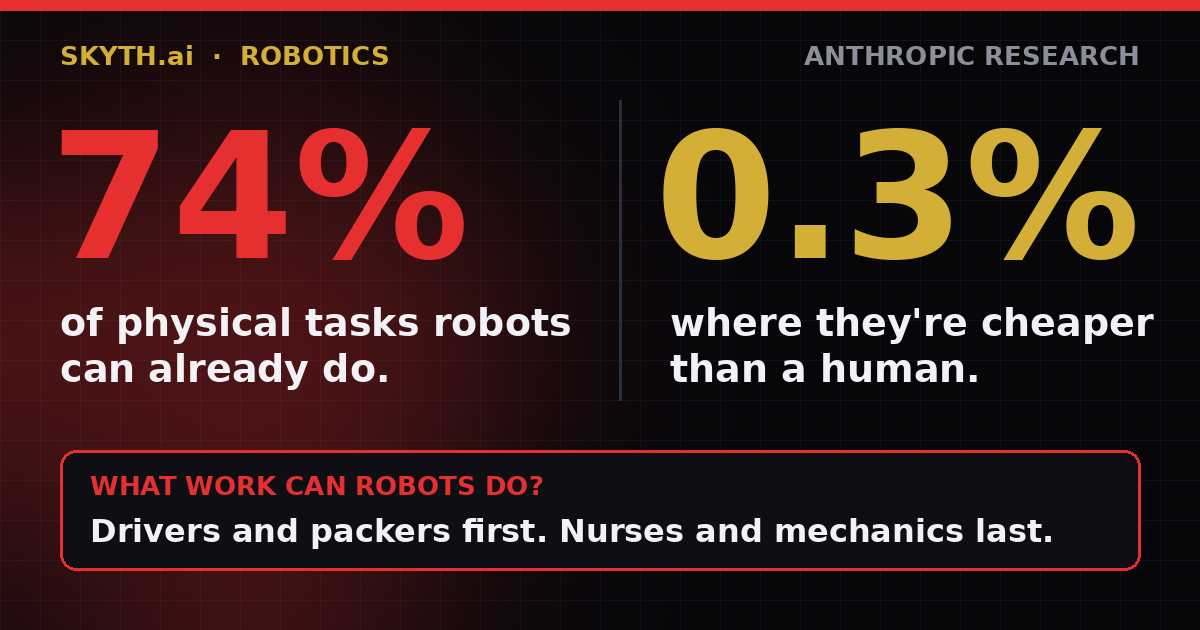
Anthropic just built a robot exposure index for every job in the US. The headline cuts both ways: today's robots can already do three-quarters of physical work in some setting, but they beat human labor on price for just 0.3% of tasks. The robot wave is real, specific and slow. It hits drivers and packers first, nurses and mechanics last.
Key Signals from the Transmission
- Robots can perform 74% of physical tasks in the US, 34% of all working hours. But mostly in purpose-built settings: half of physical tasks only in factory-style cells (E1), 22% in structured workplaces like warehouses (E2), and just 2% in the open world (E3).
- Robots plus LLMs reach about 80% of all work by time. LLMs alone cover about half; robots add the work LLMs cannot touch. Transportation and moving jumps from under 15% to about 90%; office and admin support to nearly 100%.
- Nine of the ten most exposed occupations are vehicle operators. Taxi drivers lead the index at 2.2 out of 3, shuttle drivers and chauffeurs follow at 2.0. The one non-driver in the top ten: recycling workers, at 1.7.
- The exposure map is the mirror image of the LLM map. The most robot-exposed workers are 55 points less likely to hold a degree, earn about $30 an hour less, and face more than twice the unemployment rate.
- The cost wall: robots can do 34% of all work time but are cheaper than humans for only 0.3%. For packers and packagers, a robot line of over $2 million replaces about 14 workers at roughly $45,000 per worker-year, about $2,500 under a $49,000 worker. Packer jobs are down 22% since 2015.
- Elsewhere robots lose on price, not ability: about 5x the cost of a welder, $166k vs $82k for a mail carrier, cleaning robots up to 10x slower. Robotaxis are close, about $7,000 a year more than a driver, but regulation blocks them.
- The binding constraint is the hand, not the brain: capabilities block about 70% of physical tasks, manipulation alone half; planning and reasoning, the part AI improves fastest, just 8%. Preferences block a quarter, regulation 14%.
- Timeline: at the historical 3%-a-year price decline, robots reach 10% of work in about 40 years and half of physical work by 2085; in a fast scenario, by 2050. Robots also learn about 2% of the tasks they could not do, every year.
- Why trust the method: a 50-year backtest. From 1977 on, jobs more exposed to existing robots saw bigger wage and employment declines in later decades.
What the Independent Numbers Say
- Primary source: 'What work can robots do?', Anthropic research by Russell Legate-Yang and Maxim Massenkoff, Sept 30, 2026. Robots defined as autonomous physical machines that sense and act; about 19,000 O*NET tasks scored, 7,594 classified as physical; ratings by Claude citing deployed, sold or demonstrated robots. [Anthropic]
- Cost method: Claude estimates the full annual cost for cited robots to match a worker's yearly output (hardware, integration, maintenance, supervision, energy, insurance), compared with BLS total compensation. The authors call cost-competitiveness 'more suggestive' given adoption frictions and cost uncertainty. [Anthropic]
- Packers and packagers: about 560,000 US jobs; the BLS projects the occupation will shed the 11th-most jobs of any occupation by 2035. [BLS]
- Robot prices have fallen roughly 3% a year since the 1990s (industry and government data cited in the study); reaching cost parity for 10% of work needs about a 70% decline. [Anthropic]
What This Means: The Watch List
The study's own logic: jobs change first where robots already work today. Use it as an early-warning list, not a forecast of layoffs.
Watch first
- Taxi, shuttle and delivery drivers: highest exposure, cost close to parity, regulation is the brake.
- Packers and packagers: robots already cheaper; jobs down 22% since 2015.
- Warehouse movers, recycling sorters, stockers: structured floors, proven robots.
Watch later
- Welders, cleaners, mail carriers: robots can do much of the work but cost several times more.
- Drywall and construction finishing: some tasks fully robotic, the messy ones not at all.
Hardest to automate
- Nursing, personal care, repair: hands-on, face-to-face, often regulated.
- Anything needing fine dexterity in a messy room: the robot's hand is the bottleneck.
If you run a business
- Price the robot against the whole worker-year, not the task: integration, supervision and repair are in the bill.
- Cost parity is not the tipping point; automation pays when machines are much cheaper than people.
The watch list groups the study's own examples; the study measures exposure, not job losses.
Robots can already do most physical work somewhere. They just do not pay off yet, and the bottleneck is the hand and the price tag, not the brain. That makes the robot wave specific and slow: drivers and packers first, nurses and mechanics last. If you want early signs of disruption, watch the jobs where robots already work today.
Read the research: www.anthropic.com/research/what-work-can-robots-do · Anthropic Research (Legate-Yang & Massenkoff) — curated by SKYTH.