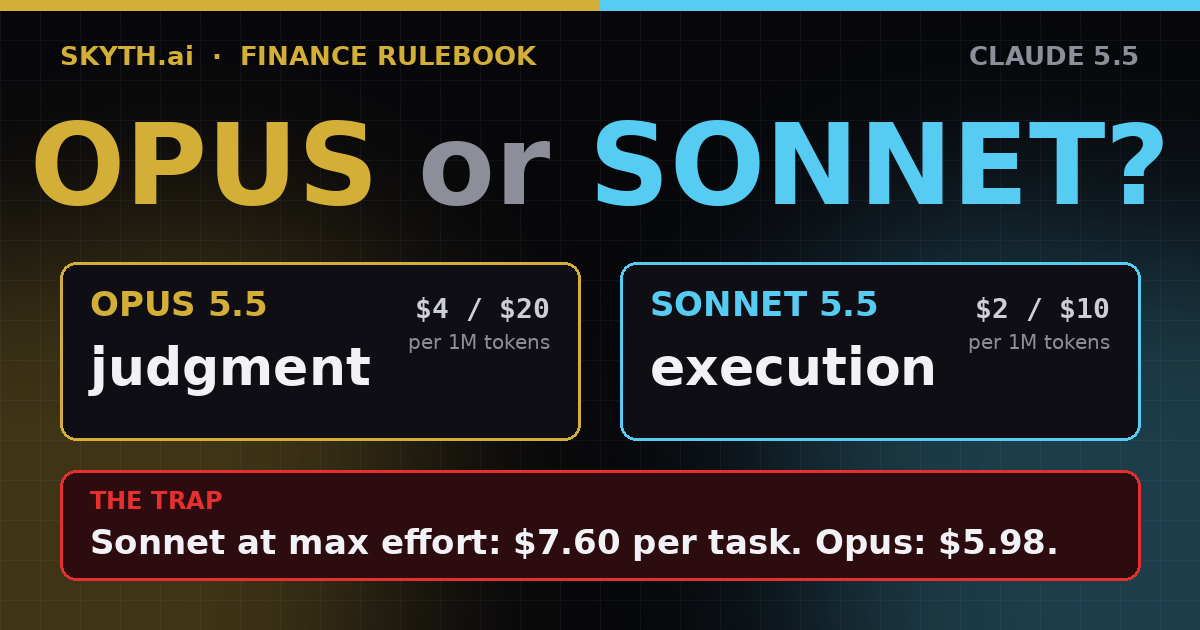
Sonnet 5.5 costs half as much per token as Opus 5.5. That headline is true and it is also how finance teams will overspend. The real rule is simpler: if you can write the definition of done, Sonnet runs it. If the task needs judgment, Opus makes the call. And if you catch yourself pushing Sonnet to max effort, you already needed Opus.
Key Signals from the Transmission
- The one-line rule: if a reviewer can check the output in two minutes against a clear definition of done, it is a Sonnet job. If the brief is vague, the stakes are strategic or the answer needs sustained judgment, it is an Opus job.
- Sonnet 5.5 is Anthropic's workhorse: 'strongest at well-scoped everyday tasks, fixing bugs, and creating polished documents, slides, and spreadsheets', and the faster of the two 5.5 models.
- Opus 5.5 is built 'for complex work requiring careful judgment'. Anthropic's own verdict: even where benchmarks are close, Opus 5.5 'remains clearly stronger at complex, open-ended work requiring sustained judgment'.
- On paper Sonnet is half the price on input and output tokens (cache reads cost the same, $0.20). On the invoice it depends on effort: at max effort Sonnet wrote about 60% more output tokens than Opus and ended up costing more per task. Half the price per token is not half the bill.
- Head to head, Opus 5.5 leads Sonnet 5.5 on 8 of 10 measures, mostly by a hair: knowledge work 1846 vs 1844, long documents 1822 vs 1811, chart reading 64.4% vs 61.6%, computer use 81.8% vs 80.1%, hard reasoning 67.7% vs 64.5%, coding sessions 57.8% vs 55.5%. Sonnet wins two: terminal agents (70.6% at max vs 66.4% at xhigh) and a lower hallucination rate.
- The gap that matters for finance is facts from memory, and it cuts both ways: Opus knows more (66% vs 54% accuracy on AA-Omniscience), but when it does not know, it guesses more often (hallucination rate 59% vs 47%). Sonnet says 'I don't know' more. Neither should be your source for tax rates.
- Best combo, in one tester's words: let Opus set the architecture, let Sonnet implement it. In finance terms: Opus designs the close process and the model; Sonnet runs it every month.
- Effort is a dial, not a free upgrade. Claude apps default to medium, the Claude Platform to high. Start low, raise it only when the checked output says so.
What the Independent Numbers Say
- Official pricing per 1M tokens: Opus 5.5 $4 input / $20 output, Sonnet 5.5 $2 / $10; cache reads $0.20 for both; Batch API 50% off; 1M-token context for both. Opus 5.5 released Sept 22, Sonnet 5.5 Sept 28, 2026. [Claude docs]
- Head-to-head launch table (Anthropic): GDPval-AA 1846 vs 1844, AA-Briefcase 1822 vs 1811, Chartography 64.4% vs 61.6%, OSWorld 2.1 81.8% vs 80.1%, Humanity's Last Exam (tools) 67.7% vs 64.5%, CursorBench 4.0 57.8% vs 55.5%, Terminal-Bench 4.0 66.4% (Opus, xhigh) vs 70.6% (Sonnet, max). Haiku 5.5 is announced for the coming weeks, not yet released. [Anthropic]
- Anthropic's positioning and its own caveat: Sonnet 5.5 for well-scoped everyday tasks, documents, slides and spreadsheets; Opus 5.5 'remains clearly stronger at complex, open-ended work requiring sustained judgment'. In an internal test, Sonnet's first draft of a 10-slide operating review from earnings materials was judged ready to send by two experts. [Anthropic]
- Independent: Sonnet 5.5 (max) scores 56 on the Intelligence Index, 2 points behind Opus 5.5, but uses ~193k output tokens per task, the most Artificial Analysis has measured, and costs $7.60 per task. AA-Omniscience: factual accuracy 54% vs 66% for Opus; hallucination rate 47% vs 59% for Opus (lower is better). [Artificial Analysis]
- Same index, Opus 5.5 at max effort: score 58 for $5.98 per task. Choose Opus 'for any task where you would otherwise run Sonnet 5.5 at max effort'. [Kingy AI]
- Finance testers (vendor-published, not independently verified): on a 2,441-task finance suite (Q&A, extraction, analysis, forecasting), Sonnet 5.5 had the best quality-to-cost of the seven models one tester ran for high-volume work; another says it rechecks data in source documents. For Opus 5.5, one tester reports 86.6% coverage of an expert rubric on end-to-end finance workflows and its best-ever citation recall; another says it caught an error in their own evaluation instructions. [Anthropic]
The Finance Desk: Who Does What
Map the task, not the model. The test is always the same: can you write the definition of done, and can someone check it quickly?
Sonnet 5.5: the month-end workhorse
- Bank and intercompany reconciliations against clear matching rules.
- Accrual, prepayment and depreciation schedules from a fixed template.
- Budget-vs-actual variance tables and the first-pass commentary.
- Fixing Excel formulas, macros and broken lookups.
- Extracting fields from invoices, contracts and bank statements into your template.
- The monthly management deck from a fixed slide template.
Opus 5.5: where judgment is the product
- M&A and valuation models, and the investment-committee memo on top.
- Revenue-recognition and lease judgments on non-standard contracts.
- Cash-flow scenarios, covenant headroom and strategic options.
- Root cause behind audit findings and control failures.
- The vague brief from the CFO that nobody can fully specify yet.
- Designing the close process, the chart of accounts or the model that Sonnet will run.
The routing matrix
- Clear spec, low stakes: Sonnet at low or medium effort, spot checks.
- Clear spec, high stakes: Sonnet at high effort, human sign-off.
- Open-ended, low stakes: Opus at medium effort, review the output.
- Open-ended, high stakes: Opus at xhigh effort, human sign-off.
- Reaching for Sonnet at max effort? Switch to Opus; it was cheaper per task in independent testing.
Non-negotiables for numbers you sign
- Tax rates, IFRS paragraphs and FX rates come from documents, never from model memory.
- Every figure traces back to a source line.
- A human signs. Always.
Task lists and the routing matrix are SKYTH's application of Anthropic's positioning and the independent numbers to finance work, not vendor guidance.
The expensive mistake in 2026 is not the token price; it is the effort dial. Default to Sonnet at medium effort for anything with a clear definition of done. Hand Opus the calls that need judgment. The moment you reach for Sonnet at max, switch: Opus scored higher for less. Sonnet runs the close, Opus makes the calls, a human signs.
Official site: www.anthropic.com/claude-sonnet-5-5 · Anthropic — curated by SKYTH.