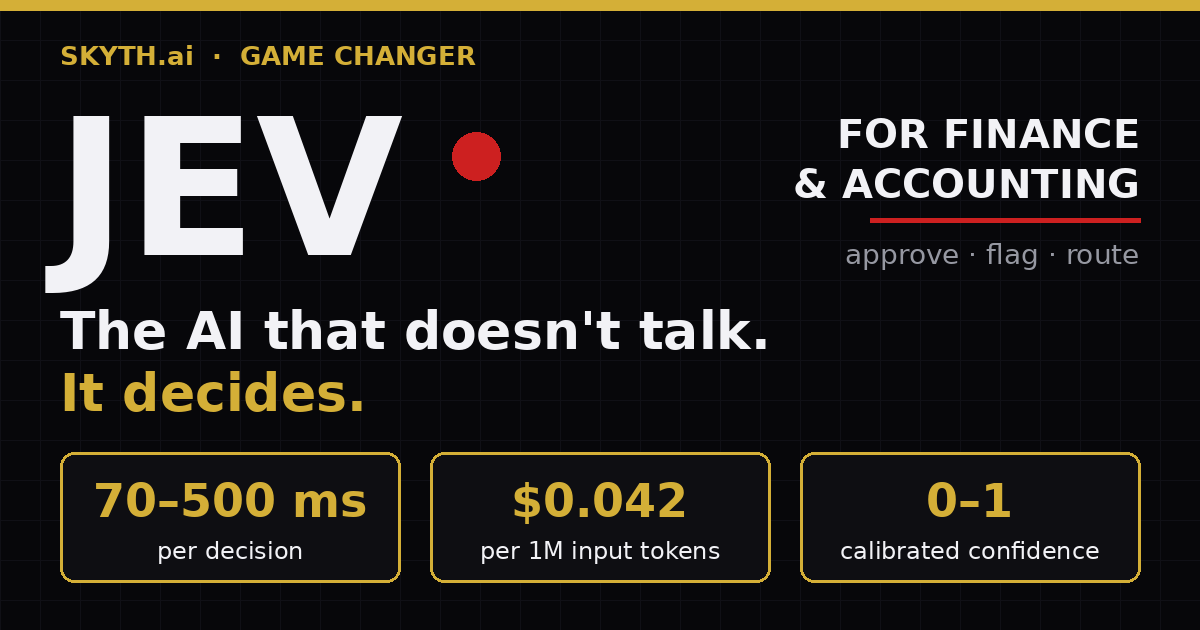
Every AI you have met so far talks. Jev does not write a single sentence. You hand it an invoice, a transaction or a request; it hands back a decision, the odds on every alternative, and how sure it is. For finance, where the question is almost never 'write me something' and almost always 'approve, flag or escalate?', that is the missing piece.
Key Signals from the Transmission
- A different species of AI. Chat models are trained to please a human reader. Jev, from San Francisco's TypeSafe AI (launched September 15, 2026, early access, $40M seed led by DCVC), is trained for calibrated decisions: you send the state of a case and typed questions, it returns the chosen option, the probability of every alternative and a confidence score from 0 to 1. It cannot invent an answer outside your list.
- Three primitives, all a finance team needs. Choice: pick one of up to 255 options (which GL account, which cost center, which approver). Score: rate on a scale (how risky is this vendor, how urgent is this dispute). Noul: a yes/no probability (is this a duplicate invoice, does this need a second signature).
- Accounts payable: triage before release. An agent gathers the invoice, the PO and the supplier history; before any payment block is released, Jev answers allow / confirm / review / deny. Only an explicit 'allow' moves the money; everything else goes to the AP clerk. An independent SAP Joule Studio build uses exactly this pattern, on mocked data.
- Spend classification at volume. Tens of thousands of invoice, PO and card lines a month, each coded to your taxonomy for a few thousandths of a cent. When Jev is unsure, accept the parent category ('Office supplies' instead of 'Toner') instead of flooding the review queue.
- Fraud and risk scoring in real time. Transactions, vendor changes, bank-detail updates: scored in milliseconds, with the confidence telling you which ones a human must look at before month-end, not after the audit.
- The economics change the design. At 70–500 ms and $0.042 per million input tokens with output free, TypeSafe claims 40–400x lower cost than frontier LLMs on comparable tasks. That makes it affordable to put a decision gate on every line, every payment and every agent tool call, not just the big ones.
- Where it stops. Jev is not a calculator and not an accountant: FX conversion, sums, date checks, matching rules and posting logic stay in code and in your ERP. Calibrated does not mean infallible; it can still misclassify, it just tells you how sure it is. Architecture and weights are unpublished, and it is still early access: shadow-test it on your own ledger before trusting it.
What the Independent Numbers Say
- Official: TypeSafe AI describes itself as an AI lab building machine-native intelligence infrastructure for automation, designed to make decisions within software; Jev is its first System One Model, in early access. [TypeSafe AI]
- Jev returns typed values with probability estimates and confidence scores rather than natural language; released September 15, 2026 with a $40M seed round led by DCVC; trained with Reinforcement Learning for Calibrated Decisions (RLCD); company-reported latency 70–500 ms and 40–400x lower cost than frontier LLMs. Architecture and weights not published. [Wikipedia]
- Independent SAP Joule Studio 2.0 experiment: a supplier-invoice triage agent may only release a payment block after an explicit Jev 'allow'; 'confirm' or 'review' hold it for human review, 'deny' blocks it; missing or malformed decisions also hold. All data mocked. [ceppek]
- Spend classification with Jev: up to 255 options per question (reliable to roughly 240), deep taxonomies asked level by level, unsure answers accepted one level up; supplier rules, amounts and dates stay in plain rules, 'Jev is not a calculator'. [AgentMelt]
Expense & Control Playbook
Every Jev call returns three things: the chosen option, the probability of every option, and a 0–1 confidence. Below a threshold you set, the item goes to a human. That is the whole control story.
Spend: where it sits
- Invoice pre-check: pay / review / reject before release. Duplicates, amounts that don't match the PO or receipt, and unusual vendors land in the review queue.
- Spend coding: every invoice and card line to GL account, cost center and project. Choice handles up to 255 options, enough for a real chart of accounts.
- Expense claims: compliant / borderline / violation. Weekend dinners, over-limit spend and missing receipts get flagged, not debated.
- Approval routing: by amount, risk and category, straight to the right approver.
Control: what the controller gets
- Fraud and risk scoring in milliseconds: vendor bank-detail changes, 'urgent CEO' payment requests, split invoices.
- An audit trail with numbers: every decision keeps its odds and confidence, so 'why did this payment go through automatically?' has an answer.
- A dial you own: e.g. auto-approve above 0.95 confidence, everything else to a human. Tighten or loosen it to match your risk appetite.
- A payment gate for AI agents: nothing an agent pays leaves without passing the same check.
What it does not do
- No sums, no reconciliation, no journal entries, no signatures. Those stay in the ERP and with you.
- Not a turnkey accounting product: it needs an ERP integration and a test on your own data.
- Speed and price figures are the company's own; the architecture is unpublished and access is early-stage.
Start here
- Pick one process (invoice pre-check is the easiest). For one month, measure the review-queue size, missed errors and time per invoice before and after Jev.
These scenarios are SKYTH's application of Jev's published decision types (Choice, Score) to finance work, not a vendor feature list.
For thirty years finance automation meant rules that break on the first exception. For three years AI meant a chatbot that writes a confident paragraph about an invoice it misread. Jev is the first piece that fits the controller's mindset: a decision, a probability, and an honest 'I am not sure, ask a human'. Put it at the gate, keep the rules and the signatures yours, and measure the review queue before and after.
Official site: typesafe.ai · TypeSafe AI — curated by SKYTH.